3 Best AI Agent Version Control Systems for Developers
Manage your agent code effectively. Review the 3 best version control systems tailored for AI agent development and iterative testing.
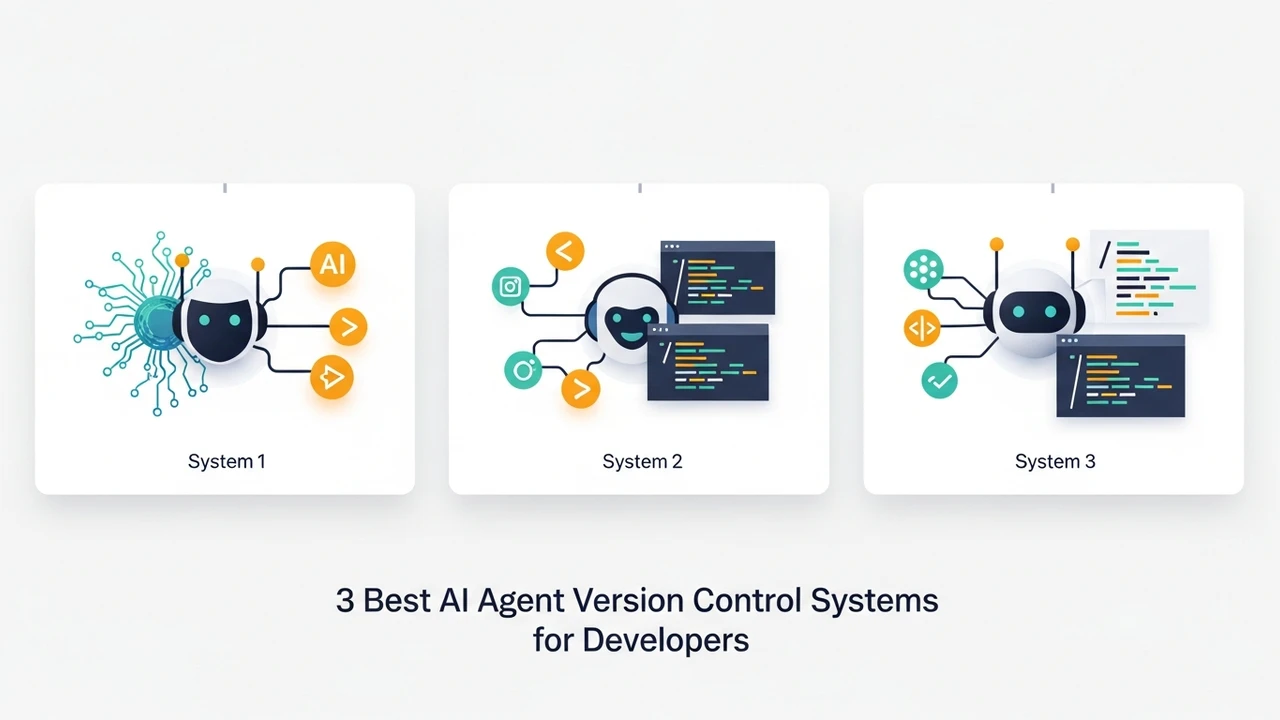
3 Best AI Agent Version Control Systems for Developers
Manage your agent code effectively. Review the 3 best version control systems tailored for AI agent development and iterative testing.
If you have been building AI agents lately, you know the struggle. Unlike traditional software where code is static, AI agents are dynamic, messy, and prone to "hallucinations" or unexpected behavior shifts. You change a prompt, and suddenly your agent stops following instructions. You tweak a temperature setting, and the output quality drops. This is why standard version control isn't enough anymore. You need systems that track not just your code, but your prompts, your model configurations, and your agent's decision-making logs. Let's dive into the best tools to keep your AI agent development under control.
Why Standard Git Is Not Enough for AI Agent Version Control
When you are working with LLMs, your "source code" is split between Python scripts and prompt templates. If you only use GitHub, you are missing the context of the model version, the system prompt, and the vector database state. Developers need a way to version the entire "agent state." This includes the model weights, the prompt engineering iterations, and the evaluation datasets. Without this, you are essentially flying blind when an agent starts acting up in production.
Top 3 AI Agent Version Control Systems Compared
We have narrowed down the top three platforms that are currently leading the market in AI-specific versioning. These tools go beyond simple code commits and offer deep integration with LLM workflows.
1. LangSmith by LangChain
LangSmith is arguably the gold standard for developers already using the LangChain ecosystem. It acts as a debugger, a testing suite, and a version control system for your prompts and chains. It allows you to trace every single step an agent takes, which is crucial for debugging complex multi-agent systems.
Use Case: Perfect for teams building complex, multi-step agents where you need to see exactly where a chain of thought went wrong.
Pricing: They offer a generous free tier for individuals, with enterprise plans starting around $500/month depending on usage volume.
2. Weights & Biases (W&B) Prompts
Originally built for machine learning experiment tracking, W&B has expanded into the LLM space. Their "Prompts" feature is excellent for versioning your prompt templates and comparing how different models (like GPT-4 vs. Claude 3.5) perform on the same task.
Use Case: Best for data scientists and ML engineers who want to treat prompt engineering like a rigorous scientific experiment.
Pricing: Free for personal projects; team plans start at $50 per user/month.
3. Helicone
Helicone is an open-source observability platform that excels at caching and versioning. It sits between your application and the LLM provider, logging every request and response. This allows you to "replay" past agent interactions to see how a specific version of your agent handled a specific user query.
Use Case: Ideal for developers who need a lightweight, high-performance solution that integrates easily with existing API calls.
Pricing: Offers a free tier for up to 100k requests, with paid tiers starting at $29/month.
How to Choose the Right Versioning Tool for Your Agent Architecture
Choosing the right tool depends on your team size and your technical stack. If you are deep into the LangChain ecosystem, LangSmith is a no-brainer. If you are more focused on the data science side of things, W&B provides the best analytical depth. For those who just want a simple, reliable way to log and replay agent behavior without changing their entire codebase, Helicone is the way to go.
Remember, the goal of these tools is to reduce the time you spend debugging. When your agent fails, you should be able to look at a version history, see exactly what prompt was used, what model version was active, and what the agent's internal reasoning was at that exact moment. That is the difference between a hobby project and a production-grade AI agent.
Best Practices for Maintaining Agent Version History
Regardless of the tool you pick, you need a strategy. Always tag your versions with meaningful metadata. Don't just call it 'v1' or 'v2'. Use tags like 'prod-stable', 'experimental-reasoning-boost', or 'customer-support-v3-beta'. This makes it infinitely easier to roll back when things go sideways. Also, keep your evaluation datasets versioned alongside your prompts. If you change a prompt, run it against your test suite immediately. If the performance drops, you know exactly which version caused the regression.
:max_bytes(150000):strip_icc()/277019-baked-pork-chops-with-cream-of-mushroom-soup-DDMFS-beauty-4x3-BG-7505-5762b731cf30447d9cbbbbbf387beafa.jpg)