3 Best AI Agent Deployment Tools for Cloud Environments
Optimize your AI agent deployment. We review the 3 best tools for managing and scaling autonomous agents in cloud-native environments.
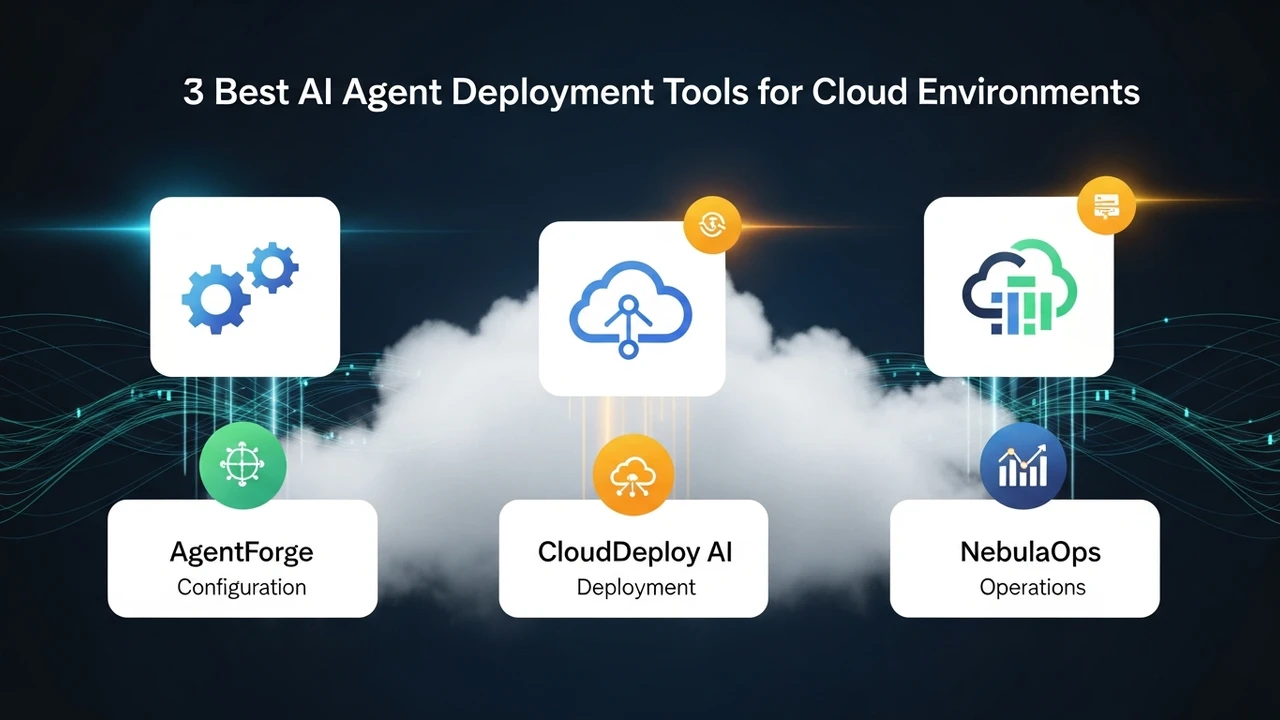
Optimize your AI agent deployment. We review the 3 best tools for managing and scaling autonomous agents in cloud-native environments.
3 Best AI Agent Deployment Tools for Cloud Environments
So, you have built an incredible AI agent. It can reason, it can plan, and it can execute tasks. But now comes the real headache: how do you actually get this thing running in the cloud without it crashing, costing you a fortune, or becoming a security nightmare? Deploying autonomous agents isn't like deploying a standard web app. These agents are hungry for compute, they need persistent memory, and they often require complex orchestration to handle multi-step workflows. If you are looking to move your agents from a local Jupyter notebook to a production-ready cloud environment, you are in the right place.
Top Cloud Infrastructure for AI Agent Orchestration and Scaling
When we talk about cloud deployment for agents, we aren't just talking about spinning up a virtual machine. We are talking about managed services that handle the heavy lifting of containerization, auto-scaling, and state management. The first tool on our list is AWS SageMaker with Agentic Workflows. AWS has been aggressively pushing its SageMaker platform to support agentic architectures. It is perfect if you are already deep in the Amazon ecosystem. You get access to robust security, VPC isolation, and the ability to trigger agents via Lambda functions. The pricing is pay-as-you-go, which is great for startups, but it can get expensive if your agents are running 24/7 inference loops.
Next up is Google Cloud Vertex AI Agent Builder. This is arguably the most user-friendly option for teams that want to integrate agents with existing enterprise data. Vertex AI provides a low-code interface to connect your agents to BigQuery or Google Search data. It is incredibly fast to deploy, and the integration with Gemini models makes it a powerhouse for RAG-based agents. If your agents need to process massive datasets in real-time, this is your go-to.
Finally, we have Modal. If you are a developer who hates dealing with YAML files and complex Kubernetes configurations, Modal is a breath of fresh air. It allows you to run serverless functions that can scale to thousands of concurrent tasks instantly. It is perfect for agents that need to perform "bursty" work—like scraping the web or processing thousands of documents at once. You only pay for the exact seconds your code runs, which makes it the most cost-effective option for many independent developers.
Comparing AI Agent Deployment Platforms and Pricing Models
Let’s break down how these compare. AWS SageMaker is the "heavy lifter." It is designed for massive scale and complex compliance requirements. You are looking at a steep learning curve, but the reliability is unmatched. Pricing is complex, involving instance hours, storage, and data transfer fees. Expect to spend anywhere from $50 to $500+ per month depending on your agent's activity level.
Vertex AI is the "enterprise integrator." It is priced per query or per node-hour. It is great for businesses that want to keep their data within the Google Cloud ecosystem. It is generally more expensive than raw compute but saves you hundreds of hours in engineering time.
Modal is the "developer's choice." It is incredibly cheap for small-to-medium workloads. You can often run a sophisticated agent for under $20 a month if you are just testing or running intermittent tasks. The lack of "enterprise bloat" makes it faster to iterate, but you might miss some of the advanced monitoring tools found in AWS or GCP.
Best Practices for Managing Autonomous Agent Workflows in the Cloud
Once you pick your platform, you need to think about state. Autonomous agents often lose their "train of thought" if the cloud instance restarts. You need a persistent database like Redis or Pinecone to store the agent's memory. Always implement a circuit breaker pattern—if your agent starts looping or hitting an API too many times, you need a kill switch. Monitoring is also non-negotiable. Use tools like LangSmith or Arize Phoenix to track what your agent is actually doing. If you don't log the reasoning steps, you will never be able to debug why your agent decided to delete a database table instead of updating it. Keep your environment variables secure, use managed secrets managers, and always, always set up billing alerts. You don't want to wake up to a $5,000 bill because your agent got stuck in an infinite loop calling an expensive LLM API.
:max_bytes(150000):strip_icc()/277019-baked-pork-chops-with-cream-of-mushroom-soup-DDMFS-beauty-4x3-BG-7505-5762b731cf30447d9cbbbbbf387beafa.jpg)