3 Best AI Career Paths in the US Market
Advance your career. Discover the 3 most in-demand AI career paths in the US and the skills you need to succeed.
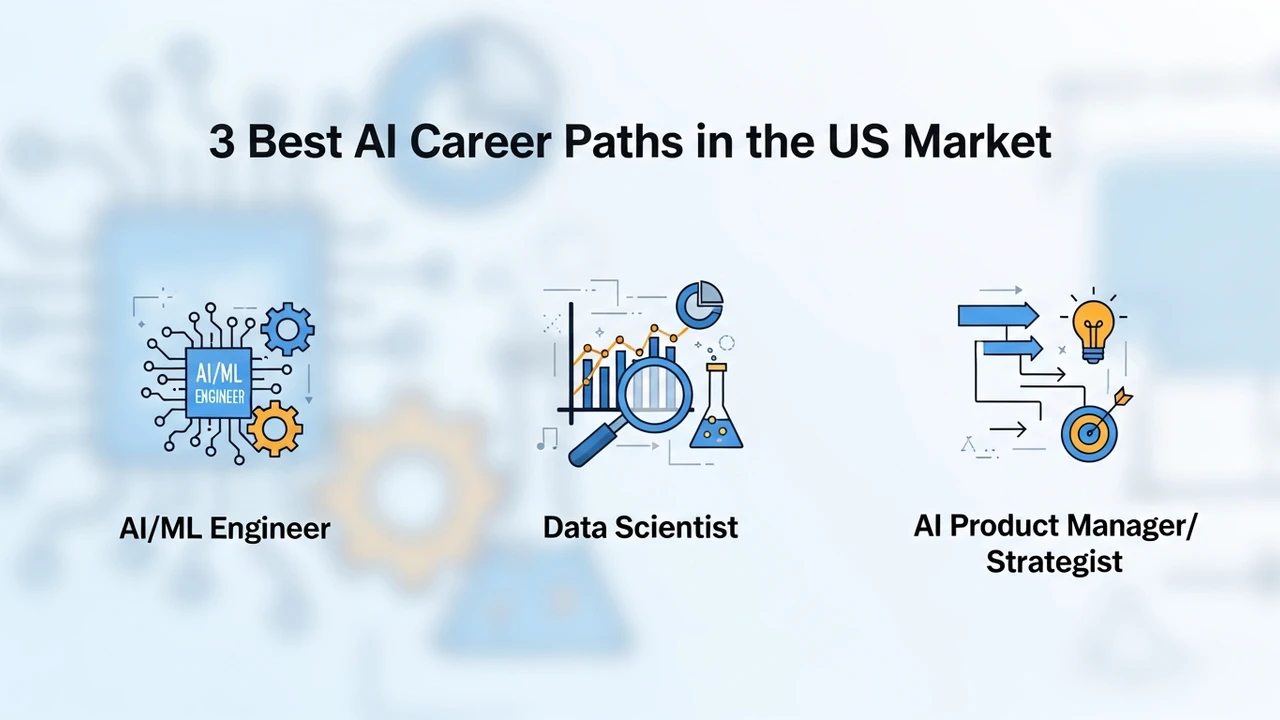
3 Best AI Career Paths in the US Market
Advance your career. Discover the 3 most in-demand AI career paths in the US and the skills you need to succeed.
So, you are looking to dive into the world of Artificial Intelligence in the United States? You are definitely not alone. The US job market is currently undergoing a massive shift, and AI is the engine driving it. Whether you are a fresh graduate or a seasoned professional looking to pivot, understanding where the demand is can save you years of aimless searching. Let’s break down the three most lucrative and stable career paths in the American AI landscape right now.
AI Machine Learning Engineer Roles and Salary Expectations
If you love getting your hands dirty with code, data pipelines, and model architecture, the Machine Learning (ML) Engineer path is your golden ticket. These professionals are the architects of the AI revolution. They don't just build models; they build the infrastructure that allows those models to scale across millions of users. In the US, the average salary for an ML Engineer often ranges from $140,000 to over $220,000 depending on the tech hub—think San Francisco, Austin, or New York.
To succeed here, you need more than just Python. You need to master frameworks like PyTorch and TensorFlow. You should also be comfortable with cloud platforms like AWS SageMaker or Google Vertex AI. These tools are essential for deploying models into production environments where latency and uptime are critical.
Data Scientist and AI Analyst Career Growth
Not everyone wants to build the engine; some people want to be the navigator. Data Scientists in the AI space are the ones who translate raw, messy data into actionable business strategies. In the US market, companies are desperate for people who can bridge the gap between complex algorithms and executive decision-making. If you can explain why a model is predicting a churn rate of 15% to a non-technical stakeholder, you are worth your weight in gold.
For tools, you will be living in Jupyter Notebooks, SQL databases, and visualization platforms like Tableau or PowerBI. The salary for a senior data scientist in the US typically sits between $130,000 and $190,000. It is a role that requires a mix of statistical rigor and business intuition.
AI Ethics and Compliance Specialist Opportunities
This is the fastest-growing niche in the US. As the government and corporations grapple with the legal implications of AI, they need people who understand the intersection of law, ethics, and technology. If you have a background in policy, law, or technical auditing, this is where you can make a massive impact. You are the one ensuring that the AI doesn't hallucinate, discriminate, or leak sensitive user data.
Tools for this path include AI governance platforms like Fiddler AI or Credo AI. These tools help monitor model bias and explainability. Salaries for AI Ethics specialists are climbing rapidly, often mirroring senior engineering roles, ranging from $120,000 to $180,000.
Comparing AI Career Tools and Platforms
To get started, you need the right training. Platforms like Coursera (offering DeepLearning.AI specializations) are the industry standard, costing around $49/month. For those who prefer hands-on labs, DataCamp is excellent for SQL and Python, priced at roughly $25/month. If you are aiming for the high-end, Udacity’s Nanodegrees are more expensive—often around $399/month—but they provide the project-based portfolio that US recruiters love to see.
Real World Application and Skill Stacking
The secret to landing these jobs isn't just a degree; it is a portfolio. If you are an ML Engineer, build a project that uses a real-world API to process live data. If you are a Data Scientist, find a public dataset on Kaggle and solve a business problem, not just a math problem. The US market values practical application over theoretical knowledge every single time. Start small, build consistently, and keep your eyes on the evolving landscape of generative AI tools, as they are changing the way we write code and analyze data every single day.
:max_bytes(150000):strip_icc()/277019-baked-pork-chops-with-cream-of-mushroom-soup-DDMFS-beauty-4x3-BG-7505-5762b731cf30447d9cbbbbbf387beafa.jpg)