3 Best AI Agent Testing Frameworks for Quality Assurance
Ensure your AI agents are reliable. Check out the 3 best testing frameworks for validating agent behavior and decision-making logic.
Ensure your AI agents are reliable. Check out the 3 best testing frameworks for validating agent behavior and decision-making logic.
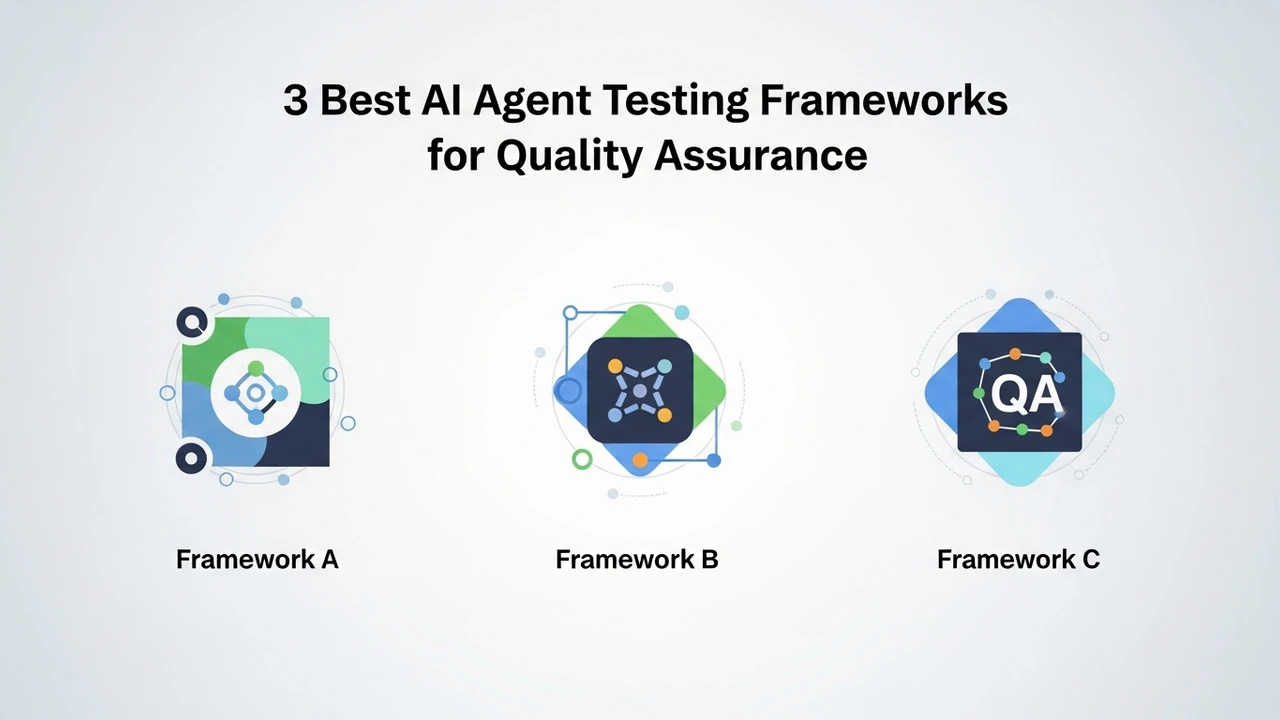
3 Best AI Agent Testing Frameworks for Quality Assurance
So, you have finally built your AI agent. It is humming along, making decisions, and interacting with your APIs. But here is the million-dollar question: how do you actually know it is not going to hallucinate or break your production database at 3 AM? Testing AI agents is a completely different beast compared to traditional software testing. You are not just checking if a function returns 'true' or 'false'; you are evaluating reasoning, context retention, and safety guardrails. If you are feeling a bit lost in the woods, you are not alone. Let’s dive into the best frameworks that are currently changing the game for AI quality assurance.
Why Traditional Testing Fails for Autonomous AI Agents
In the old days, we used unit tests. You input 'A', you expect 'B'. Simple. But AI agents are non-deterministic. They use LLMs that might give you a slightly different answer every time. If you try to use standard unit testing, your tests will fail constantly just because the wording changed. You need frameworks that understand semantic similarity, agentic workflows, and multi-step reasoning. Without these, you are basically flying blind.
Top 3 AI Agent Testing Frameworks for Robust Performance
After testing dozens of tools, three stand out for their ability to handle the complexity of modern agentic systems. These tools focus on observability, evaluation, and automated feedback loops.
1. LangSmith by LangChain
LangSmith is arguably the gold standard right now for anyone building on the LangChain stack. It is not just a testing tool; it is a full-blown observability platform. You can trace every single step your agent takes, which is crucial when you are trying to figure out why an agent decided to call a specific tool.
Use Case: Perfect for complex multi-agent systems where you need to debug the 'thought process' of the agent. It allows you to run 'evals' on your prompts and agent logic to see how changes affect performance over time.
Pricing: They have a generous free tier for individuals, with enterprise plans that scale based on usage. It is very accessible for startups.
2. DeepEval by Confident AI
If you love unit testing and want to bring that same rigor to AI, DeepEval is your best friend. It is an open-source framework that lets you write tests for your LLM outputs using metrics like 'hallucination detection', 'answer relevancy', and 'bias'.
Use Case: Ideal for CI/CD pipelines. You can integrate DeepEval into your GitHub Actions so that every time you push code, your agent is automatically tested against a suite of benchmarks.
Pricing: Open-source and free to use, with a managed cloud version available for teams that want a dashboard without the headache of hosting.
3. Promptfoo
Promptfoo is all about speed and simplicity. It is a command-line tool that lets you test your prompts and agent outputs against a set of test cases. It is incredibly fast and gives you a clear matrix of how your agent performs across different models (like GPT-4 vs Claude 3.5).
Use Case: Best for rapid prototyping. If you are constantly tweaking your system prompts and want to see if those changes break your agent's core functionality, this is the tool to use.
Pricing: Free and open-source. It is a developer-first tool that requires zero setup time.
Comparing the Frameworks for Your Specific Needs
Choosing the right one depends on your team's technical depth. If you are a heavy LangChain user, LangSmith is a no-brainer. If you are a developer who wants to treat AI testing like standard software engineering, go with DeepEval. If you just want to quickly compare how different prompts perform, Promptfoo is the way to go.
Think about your workflow. Are you testing in production? Do you need to simulate user interactions? Most teams actually end up using a combination. They use Promptfoo for early-stage prompt engineering and LangSmith for long-term monitoring and debugging.
Best Practices for Implementing AI Agent Quality Assurance
Don't just set up a framework and walk away. You need a 'Golden Dataset'. This is a collection of inputs and expected outputs that represent the 'perfect' behavior of your agent. Every time you update your agent, run it against this dataset. If the performance drops, you know exactly what broke. Also, make sure to include 'adversarial testing'—try to trick your agent into doing things it shouldn't. If you don't break your own agent, your users definitely will.
The landscape of AI testing is moving fast. New tools are popping up every week, but these three have the strongest community support and the most reliable feature sets. Start small, pick one, and integrate it into your development cycle today. Your future self—and your users—will thank you when your agent stays stable under pressure.
:max_bytes(150000):strip_icc()/277019-baked-pork-chops-with-cream-of-mushroom-soup-DDMFS-beauty-4x3-BG-7505-5762b731cf30447d9cbbbbbf387beafa.jpg)