AgentGPT vs Microsoft AutoGen Feature Comparison
A head-to-head comparison of AgentGPT and Microsoft AutoGen. Learn which platform provides better support for collaborative multi-agent workflows.
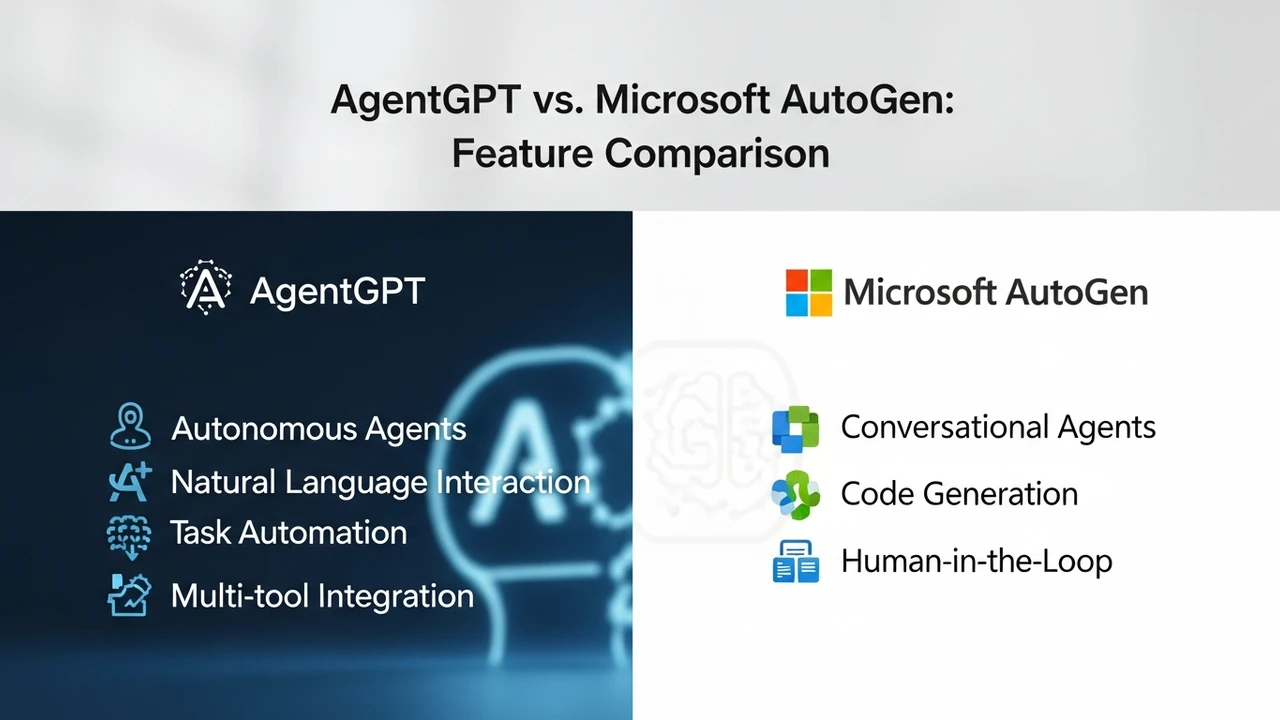
A head-to-head comparison of AgentGPT and Microsoft AutoGen. Learn which platform provides better support for collaborative multi-agent workflows.
AgentGPT vs Microsoft AutoGen Feature Comparison
If you have been diving into the world of autonomous AI agents, you have likely stumbled upon two heavy hitters: AgentGPT and Microsoft AutoGen. It is a classic battle of accessibility versus raw power. On one side, you have AgentGPT, the friendly, browser-based interface that lets you spin up agents in seconds. On the other, you have Microsoft AutoGen, a robust framework that feels like a playground for developers who want to build complex, multi-agent systems. Choosing between them is not just about which one is 'better'—it is about what you are actually trying to build.
Understanding the Core Philosophy of AgentGPT and AutoGen
Let’s start with the vibe. AgentGPT is all about the 'wow' factor. It is designed to be the easiest entry point into the world of autonomous agents. You go to a website, type in a goal, and watch the agent break it down into tasks. It is perfect for someone who wants to see AI in action without touching a single line of code. It is essentially a wrapper around GPT models that manages the loop of thinking, acting, and reflecting for you.
Microsoft AutoGen, however, is a different beast. It is a framework, not just a tool. It is built for developers who want to orchestrate conversations between multiple agents. Imagine one agent acting as a coder, another as a reviewer, and a third as a project manager. AutoGen allows these agents to talk to each other, debate, and refine their work. It is less about 'click and go' and more about 'code and scale'.
Key Features and Capabilities of AgentGPT
AgentGPT shines in its simplicity. Its primary feature is the web-based dashboard. You don't need to install Python, manage API keys in environment variables, or worry about Docker containers. You just log in, set your agent's name and goal, and hit 'Deploy'.
The platform is great for quick tasks like market research, drafting simple content plans, or brainstorming ideas. Because it is so visual, you can see the agent's thought process in real-time. If you are a non-technical user or a small business owner who needs a quick task automated, this is your go-to. However, it does have limitations. It is not designed for long-term, complex projects that require persistent memory across different sessions or deep integration with your local file system.
Deep Dive into Microsoft AutoGen Architecture
Now, let’s talk about the heavy lifting. AutoGen is built on the concept of 'conversable agents'. In AutoGen, you define agents with specific roles. You can give them system prompts, tools, and even human-in-the-loop capabilities. The real magic happens when you define the 'group chat' or 'sequential' workflow. You can have an agent write a Python script, another agent execute it, and a third agent check the output for errors.
This is where AutoGen leaves AgentGPT in the dust. If you are building a system that needs to interact with a database, scrape complex websites, or perform multi-step data analysis, AutoGen is the framework you want. It is highly customizable, allowing you to swap out models, add custom tools, and control the conversation flow with surgical precision.
Comparing Use Cases for AI Agent Platforms
When should you use which? If you are a marketer needing to generate a list of blog topics or a student trying to summarize a long document, AgentGPT is your best friend. It is fast, intuitive, and requires zero setup. You get your answer, you copy it, and you move on.
But if you are a software engineer building a custom customer support bot that needs to query your internal API, or a data scientist creating an automated report generator, you need AutoGen. AutoGen allows you to build 'agents' that are actually part of your software stack. You can deploy them on your own servers, integrate them into your CI/CD pipelines, and scale them to handle thousands of requests.
Pricing and Accessibility Breakdown
AgentGPT operates on a freemium model. You can use the basic version for free, but if you want faster agents, longer task history, or more advanced models, you will need to pay for a subscription. It is a 'Software as a Service' (SaaS) approach. You are paying for the convenience of not having to manage the infrastructure.
AutoGen is open-source. It is free to use, but the 'cost' comes in the form of development time and infrastructure. You need to host it yourself, manage your own OpenAI or Azure API keys, and handle the maintenance. If you are a developer, this is usually the preferred route because you have total control over your data and your costs.
Which Platform Wins for Your Business Needs
If you are looking for a quick win, start with AgentGPT. It is the fastest way to get a feel for what autonomous agents can do. It is a great tool for prototyping and simple automation. But don't get too comfortable. As soon as you find yourself hitting a wall—needing more control, better memory, or complex multi-agent interactions—it is time to migrate to AutoGen.
The future of intelligence is clearly moving toward these collaborative systems. Whether you choose the ease of AgentGPT or the power of AutoGen, the key is to start experimenting today. The tools are evolving rapidly, and the gap between 'simple' and 'powerful' is closing every single day. Just pick a project, pick a tool, and start building.
:max_bytes(150000):strip_icc()/277019-baked-pork-chops-with-cream-of-mushroom-soup-DDMFS-beauty-4x3-BG-7505-5762b731cf30447d9cbbbbbf387beafa.jpg)