5 Essential AI Agent Monitoring Tools for Performance
Keep your AI agents running smoothly. Discover the 5 best monitoring tools to track performance, latency, and decision-making accuracy.
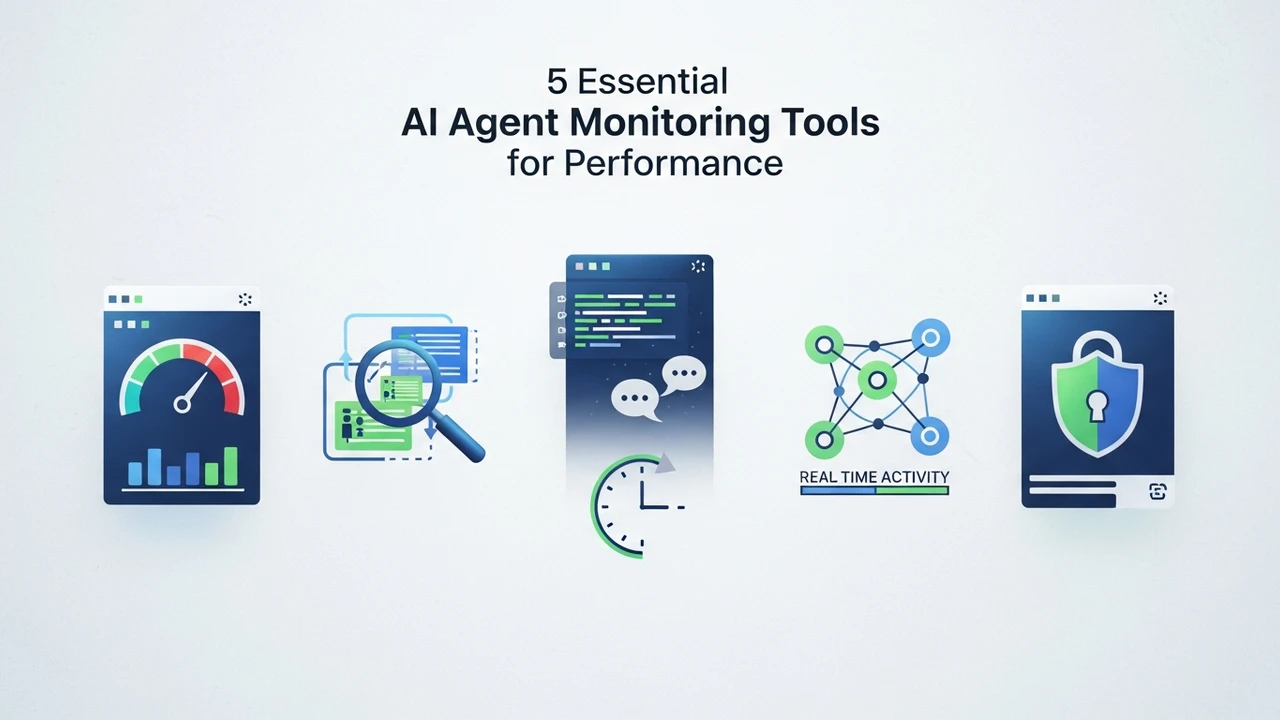
5 Essential AI Agent Monitoring Tools for Performance
Keep your AI agents running smoothly. Discover the 5 best monitoring tools to track performance, latency, and decision-making accuracy.
So, you have finally deployed your AI agents. They are out there in the wild, handling customer queries, automating complex workflows, or crunching data. But here is the million-dollar question: do you actually know what they are doing? If you are just crossing your fingers and hoping for the best, you are setting yourself up for a disaster. AI agents are not like traditional software; they are unpredictable, prone to hallucinations, and can sometimes get stuck in infinite loops. That is why you need robust monitoring tools. Let’s dive into the best ones on the market right now.
Why AI Agent Observability and Performance Tracking Matters
Think of AI agents as digital employees. You wouldn't hire someone and never check in on their work, right? Monitoring tools provide the visibility you need to ensure your agents are not just working, but working correctly. We are talking about tracking latency, token usage, cost, and, most importantly, the quality of the output. Without these tools, you are flying blind. You might be burning through your API budget because of a poorly optimized prompt, or worse, your agent might be giving your customers completely wrong information. Observability is the backbone of any production-grade AI system.
Top 5 AI Agent Monitoring Tools for Enterprise Success
There are a lot of tools out there, but not all of them are built for the complexities of autonomous agents. Here are the five that actually move the needle.
1. LangSmith by LangChain
LangSmith is arguably the gold standard for developers working within the LangChain ecosystem. It is designed to help you debug, test, and monitor your LLM applications. It gives you a deep dive into the trace of every single interaction. You can see exactly where a chain failed, how long each step took, and what the intermediate outputs were. It is incredibly powerful for fine-tuning your prompts and understanding the decision-making logic of your agents.
Use Case: Perfect for complex multi-agent systems where you need to debug the chain of thought.
Pricing: Offers a generous free tier for individuals, with enterprise plans starting around $500/month depending on usage.
2. Arize Phoenix
If you are looking for open-source observability, Arize Phoenix is your best bet. It focuses heavily on LLM tracing and evaluation. What makes it stand out is its ability to visualize the entire lifecycle of a request. It is great for identifying bottlenecks in your agent's reasoning process. Plus, it integrates seamlessly with most major frameworks.
Use Case: Ideal for teams that want to host their own monitoring infrastructure and need deep evaluation capabilities.
Pricing: Free open-source version; enterprise managed services are available upon request.
3. Helicone
Helicone is all about the metrics. If you are worried about costs and latency, this is the tool for you. It sits as a proxy between your application and the LLM provider, giving you real-time insights into token usage, cost per request, and latency. It is incredibly easy to set up—you basically just change your API base URL, and you are good to go.
Use Case: Best for startups and businesses that need to keep a tight leash on their API spending and performance metrics.
Pricing: Free tier available; Pro plans start at $99/month.
4. Weights and Biases (W&B) Prompts
W&B is a legend in the machine learning space, and their Prompts tool is a fantastic addition for AI agents. It allows you to log and visualize your prompts and responses, making it easy to compare different versions of your agent's logic. It is very collaborative, which makes it great for teams where multiple people are working on prompt engineering.
Use Case: Excellent for teams that need to track experiments and version control their prompts.
Pricing: Free for personal use; team plans start at $50 per user/month.
5. LangFuse
LangFuse is an open-source observability platform that is gaining a lot of traction. It is very developer-friendly and focuses on providing a clear view of the entire trace. It is particularly good at handling complex, multi-step agent workflows. The UI is clean, intuitive, and makes it very easy to spot where things are going wrong.
Use Case: Great for developers who want a lightweight, easy-to-use tool that doesn't sacrifice power.
Pricing: Free for small projects; cloud-hosted plans start at $99/month.
Comparing AI Agent Monitoring Solutions
When choosing a tool, you have to consider your specific needs. If you are deep into the LangChain ecosystem, LangSmith is a no-brainer. If you are a startup watching every penny, Helicone is going to be your best friend. For teams that need to do heavy evaluation and testing, Arize Phoenix or W&B are the way to go. It is not about which one is 'best' in a vacuum, but which one fits your current stack and your team's workflow. Don't be afraid to try a few out—most of these have free tiers that let you get a feel for the interface before you commit to a paid plan.
Best Practices for Maintaining Agent Performance
Monitoring is only half the battle. You also need to act on the data you collect. Set up alerts for latency spikes or sudden increases in error rates. Regularly review your logs to see if your agents are drifting in their behavior. And always, always keep a human in the loop for critical decisions. AI agents are powerful, but they are not magic. They need guidance, oversight, and constant tuning to stay effective. Keep your eyes on the dashboard, keep your prompts updated, and you will be well on your way to building a truly intelligent and reliable agent system.
:max_bytes(150000):strip_icc()/277019-baked-pork-chops-with-cream-of-mushroom-soup-DDMFS-beauty-4x3-BG-7505-5762b731cf30447d9cbbbbbf387beafa.jpg)